I’m super excited to announce that my latest novel, co-written with my friend German, will be available at the end of the month. The quick pitch for Journey is “Black Sails” meets “The Expanse”: it’s hard sci-fi, realistically gritty with a cyberpunk edge. The e-book will be $2.99 and is available for pre-order now; the paperback will be $15.99 and available on May 28th. The amazing cover art is by J. Ottó Szatmári.
Back-of-the-book summary:
2120: A hostile corporate takeover leaves the asteroid miners of Journey Station stranded and starving. Desperate for supplies, they hijack a shipment bound for Mars.
This first act of piracy in space demands a response from the fractious nations of Earth, themselves already teetering on the brink of war. But the Martian colony—suddenly bereft of their water shipment—is forced to thaw research ice drawn from the poles, and inadvertently wakes something ancient and alien.
Caught in the maelstrom of opposing forces are the ruthless commander Bardo Arai, willing to cross any line to protect his people; space trucker-turned-bounty hunter Miriam Liberski, whose quest for justice will drive her across the solar system; and Rue Áine Torverd, an indentured sex worker who finds her courage and conscience both challenged when she chooses a new life as a pirate.
A sweeping space opera that weaves together tales of survival, vengeance, and transcendence, Journey explores what it means to be human in an increasingly post-human solar system. When the heroes and villains depend on perspective…whose side are you on?
So I’m doing a Substack! It’ll be a piece of speculative fiction every Monday, starting with short stories and moving into serialized novels. The welcome message talking about my writing career is here: joshannonphillips.substack.com/p/welcome
And the first short story, “The Lady of Roch Shan,” is here. It’s about a wise-woman in a Celtic fantasy landscape forced to pit her craft against the schemes of a wayward noblewoman and her fairy lover. It was the first story I ever sold, to Dragon magazine back in 1994, and I’ll always be grateful to Wolfgang Baur who was the editor then. I talk a little bit in the introduction about how much Dragon meant to me, growing up.
All the entries will be free; if you want to support my writing, the best way is to share it.
At the rate royal “bombshells” drop, one might imagine Buckingham Palace a smoking crater of charred ruins.
But after years of drama, not only do all the grand old piles in the British royal family’s vast portfolio of real estate still stand, but the royal machinery that sustains them isn’t even dinged. And that’s because all the smoke and dazzle is part of a calculated strategy, a show cooked up in concert between “the Firm” and the tabloids that profit from royal clickbait. The gossipy headlines generate profit for the papers, sustain public interest in Britain’s royal family, and provide a useful way to punish members who don’t toe the institutional line.
Prince Harry’s biography Spare became the fastest-selling nonfiction book of all time and generated countless media headlines. Omid Scobie’s Endgame is currently providing chum for another tabloid feeding frenzy.
But ironically, both books are packed with stories the tabloids won’t repeat, because they illuminate too much of the “invisible contract” between palace and press.
In probably the best coverage of Spare, Zeynep Tufekci wrote for the New York Times: “Any close follower of the British media should not have been surprised that after Prince Harry fell in love with Meghan Markle, the biracial American actress, years of vitriolic, even racist coverage followed. Whipping hatred and spreading lies — including on issues far more consequential than a royal romance — is a specialty of Britain’s atrocious but politically influential tabloids.
“People like me, uninterested in celebrities, shouldn’t dismiss the brouhaha around Harry’s memoir as mere celebrity tittle-tattle. He has made credible, even documented claims that his own family refused to stand up against their ugly, sustained attacks against Meghan. In other words, it appears that Britain’s most revered institution, funded by tens of millions in taxpayer funds annually, plays ball with one of its most revolting institutions.
“At the very least, it seems clear by now where some senior members of the royal family position themselves in all this.”
Endgame goes even farther than Spare in detailing the often sordid workings of the invisible contract between journos and courtiers. Scobie details how Christian Jones, Prince William’s communications secretary, fed negative stories about the Sussexes to Dan Wootton at TheSun in exchange for burying another story that might have been highly damaging to the heir: reports of private dinners and a “rural rivalry” that hinted at an affair between Prince William and Rose Hanbury, the Marchioness of Cholmondeley.
No proof or confirmation of that royal affair was ever provided, because after Jones’s intervention, those articles were comprehensively scrubbed from The Sun’s website. Instead, the paper was apparently allowed to break the story of what it would call “Megxit”: Harry and Meghan’s desire to separate themselves from the Firm.
According to both Endgame and a report by the Byline Times, when Harry pursued legal action against The Sun, he was punished by the withdrawal of his official security. (It’s worth noting that the disgraced Prince Andrew is still provided security, despite having a much lower threat profile than Harry.) Scobie quotes a source as saying: “I have never seen the Palace circle the wagons like they did with Christian.” Byline Times also quotes a source: “They threatened the removal of the funding to try and protect the royal household from a potential courtroom scandal with Jones and Wootton very publicly at the centre.”
Why would the Firm pull out all the stops to protect a courtier, even if it meant putting the monarch’s own second son in real and immediate danger?
Because Jones is merely a flunky for Prince William, and it’s hard to imagine that Jones’s press machinations were conducted without the approval of his “principal.” Indeed, he wasn’t William’s only communications secretary to openly collude with the tabloids against Harry and Meghan: another highly placed aide, Jason Knauf, gave testimony on behalf of the Daily Mail in a case brought against it by the Duchess of Sussex, regarding the leak of a private letter. (Despite the attempted sabotage from William’s camp, she won that case and was awarded a front page correction and a large settlement.)
The details of all this sordidness — the sacrifice of Harry and Meghan on the altar of tabloid drama, with obsidian knives wielded by Harry’s own closest kin in an attempt to secure more favorable coverage for themselves — form the narrative backbone of both books. And William isn’t the only one implicated in the matter: Queen Camilla emerges as a canny and ruthless operator, buying the rehabilitation of her own image with the coin of gossip leaked against both her stepsons.
“In a funny way I even wanted Camilla to be happy,” Harry writes. “Maybe she’d be less dangerous if she was happy.”
It’s pretty hard to tell if anyone’s happy in Britain’s royal family. Endgame tells us that Charles is jealous of William, that William is jealous of Harry, and that Harry will probably never get any of the remorse he’d like to see for the way he and his wife were thrown to the wolves. Hating Harry — and even more so, Meghan — has become its own lucrative, self-sustaining industry. Literally hundreds of negative articles are published about the two every day. It’s a relentless, often racist onslaught of character assassination that exploits the same culture-war fissures that drove Brexit.
Spare mostly comes off as a good-faith effort from a deeply weird person to explain to the rest of us why he’s like this. Endgame isn’t as well-written or compelling, but it backs up a lot of what Harry puts into generalizations with names, dates, and specifics. Together, they paint a very damning portrait of two rotten institutions propping each other up at the people’s expense.
But by and large, you won’t read about that in the press.
You’d be stupid to expect wishes–on stars, or pennies in fountains; on birthday candles or dandelions–to come true. But on the other hand you’d be stupid to pass up a bargain?
This has anyway been my principle, whenever fate finds me blowing a dandelion. I have a standard wish that I make, when presented with a typical wishing situation.
And I know that I’m probably violating the warranty here by disclosing the exact nature of my terms, but I never actually wish for more than what I have. I only ask the cosmos for some kind of insurance, for a safety net, for the assurance that the worst case scenario won’t hit me.
I always wish “for nothing too bad to happen to any of my kids.” And I don’t define too bad. I suppose with our special needs kid that we’ve already passed some people’s idea of “too bad,” but to us he’s a blessing, so. I will let the universe surprise me and teach me things. I’m not asking to always be in control.
I just hope, for my kids and if I’m being honest for myself, that at the moment of death we’ll count it all worth it. We won’t think the cost was too high, for what we got in exchange. Right now I feel like I’d pay any price for what I already have.
(We’re just back from a family trip to Disneyland, so I’m thinking about the nature of wishes. And costs!)
Whelp, Robin came down with a sore throat over the weekend, and tested positive for Covid. He seems to be bouncing right back. He had a fever too but that’s gone, and even the sore throat is better now.
Meanwhile we’ve been testing everybody else, all negative. We kept the other kids home for a couple days out of caution, but school guidance is currently to send them back so long as they are testing negative and have no symptoms, so back they went today.
And this…seems to be how it’s going, mostly, across the country? Infections spiking everywhere, but nothing like the previous waves of severity? Knock on wood this is really gonna be what it looks like, a very soft-hitting wave of infections, that ripples and spreads and then disappears.
This morning I was sitting in bed playing Animal Crossing in a loose nightshirt with my hair all rumpled, and Sam came in starting to tell me something, but just broke off right in the middle of it. “You are so cute,” he said, and kissed me a dozen times all over my face. These moments are real common and I don’t usually write about them because it feels like bragging.
But I do feel a strong urge to write/journal/reach out for connection when things are scary or sad, so I should probably write about the everyday nice things too sometimes, or it leaves a distorted record. Robin has covid so that’s kinda scary, and my husband thought I was cute today so that was nice, and both things happened at the same time and both felt basically normal: this is what normal is, right now.
Update 1/20: Robin’s fine and back in school. He only had symptoms for like a day, and none of the rest of us got breakthrough infections. I was a little surprised given how transmissable this thing is, but vaccines+boosters for the win!
Well this is a fun first for me! Delighted to have a story featured on the sci-fi podcast StarShipSofa. “Strangers When We Meet” is queer cyberpunk noir written in collaboration with my friend Chad (and with the help of some good friends who gave feedback on the first draft–thanks again, guys!)
The title is a Bowie nod. He in turn was referencing an earlier movie when he used it for a song title on his album Outside, and I liked the idea of continuing the chain.
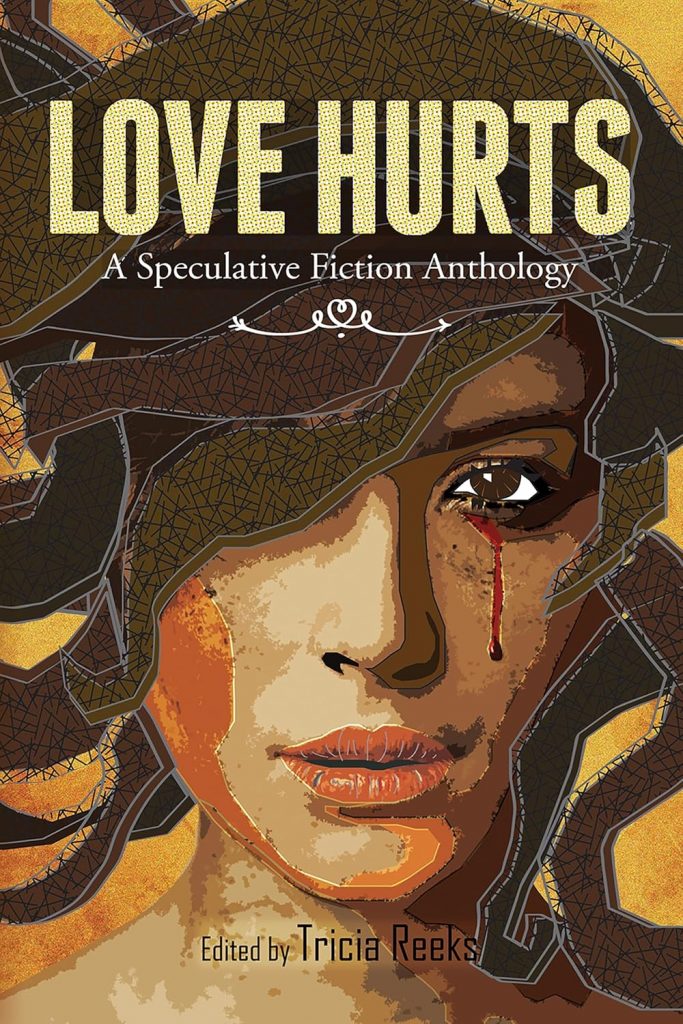
I’m very pleased that my short story “Favor”, originally published in the Love Hurts anthology from Meerkat Press, has been reprinted in the latest issue of The Were-Traveler (Issue 22: Women Destroy [Retro] Sci-Fi!!!)
When I lost my dog… And let me stop here because I need you to understand that she was a mastiff.
That means she was a huge girl who needed leash training and needed doggy kindergarten training but never needed protection training; you don’t ever do that, with mastiffs, because protection training involves putting a dog’s person in simulated threat and prompting them to fight on behalf of their person. A mastiff will do that anyway, and they will do it very well, and any “training” scenarios would be a) distressing for the dog, and b) dangerous for the people pretending to be threats.
Most mastiffs in a home-burglary situation will use their weight and ferocious bark/growl to immobilize intruders: they’re pretty famous for sitting on would-be burglars until the police come round. (These dogs get to be about 200 pounds, depending. Thora was on the slim side but trust me, nobody wanted to try her.) They don’t enjoy fucking people up. They are gentle giants. They bite as a last resort.
But they absolutely will do it, in defense of their person.
I was Thora’s main person, and she never needed training. She knew in her bones that guarding the house and the people in it was her job. She wouldn’t stray far from me, but she liked to plop her entire bulk down in the middle of hallways so that she could get sightlines to everyone else in the house as well. She guarded us from dawn to dusk and round through the night too. She was on top of it, in a lounge-y way. If I went to get a glass of water from the kitchen it would be to the accompaniment of scrabbling claws on hardwood and the soft effortful grunts of a mastiff heaving herself up, because she could not let me out of her sight.
When I was sick, she would be lying at the side of the bed.
When she was sick, finally, of old age, she went out into the yard and stretched out under my window. When it became clear she wasn’t coming back in I went out and stayed with her, trying to coax her to drink chicken broth; we couldn’t move her without her cooperation, so we found a vet that would come to us, but by the time the vet came it was for funerary services.
Anyway, so, when I lost my dog, I never stopped feeling her presence. It’s been twenty months since she died and the reason I made this post is because I absentmindedly just leaned over to scritch the vacancy where her ears would be, if she was lying in the place where she ought to be. I can feel with absolute clarity the space her ghost takes up, and I never want it to leave me.
Don’t ever buy a mastiff. Rescuing ones that already exist and need homes is different, if you know what you’re doing, but I’ve become convinced that it is immoral to knowingly create beings so good who only live for such a short time. Big dogs live shorter lives, and seven to nine years is not enough. Much better to have a less saintly dog that lives longer. That mastiffs exist at all is a reproach to the arrogance and hubris of humankind: we thought we’d make something good. We weren’t prepared for the cost of loving and losing them so soon.
Someday I might adopt another mastiff, as a rescue, but only if I’m ready for another ghost.
These are strange times. We are mostly holed up at home trying to practice responsible social distancing during a global pandemic, but we do go for walks. I took this picture of Robin on one of them.
So I glanced out at the back yard this afternoon and realized I’ve created some kind of Blair Witch masterpiece back here.
First, there’s the defunct chicken coop, still echoing after all these years with the memory of raccoon screeching and blood. You can just look at some buildings and know that a massacre happened there. (I’m so sorry, my fluffybutt girls.) A deeply haunted energy, as the kids say.
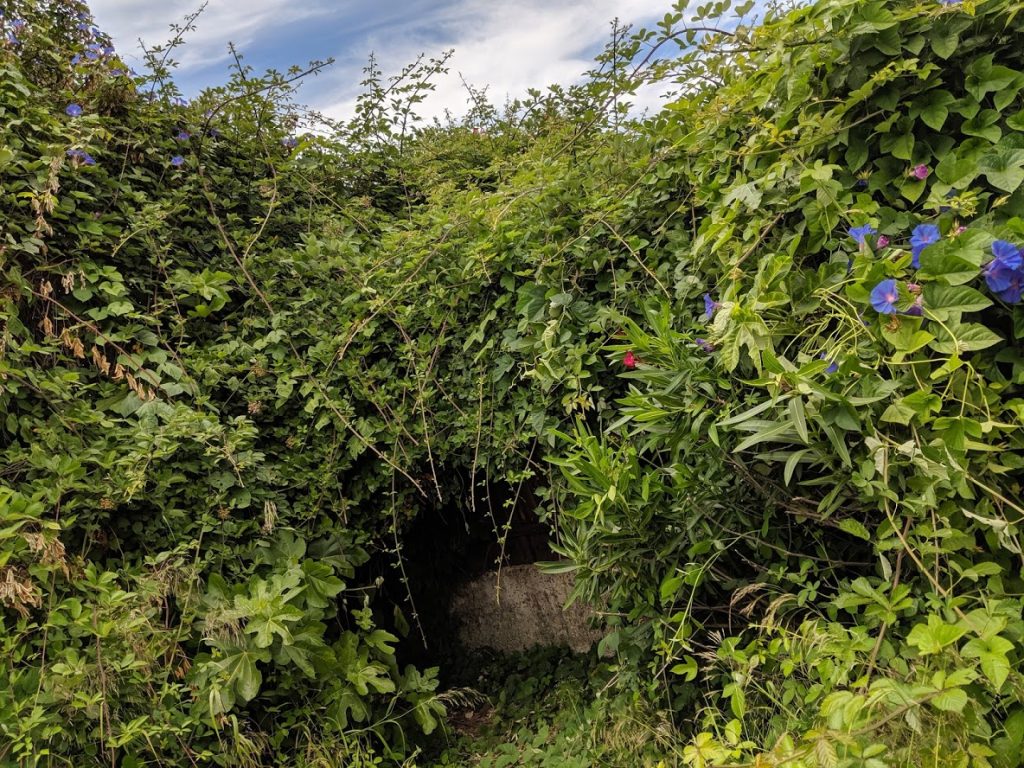
Secondly, that vine-covered tree in the distance that fell over more than a decade ago and refused to die. It’s just growing on its side now, looking up at the blackberries and morning glories draped across it like “this is fine.” And if you go around to the other side it looks like this:
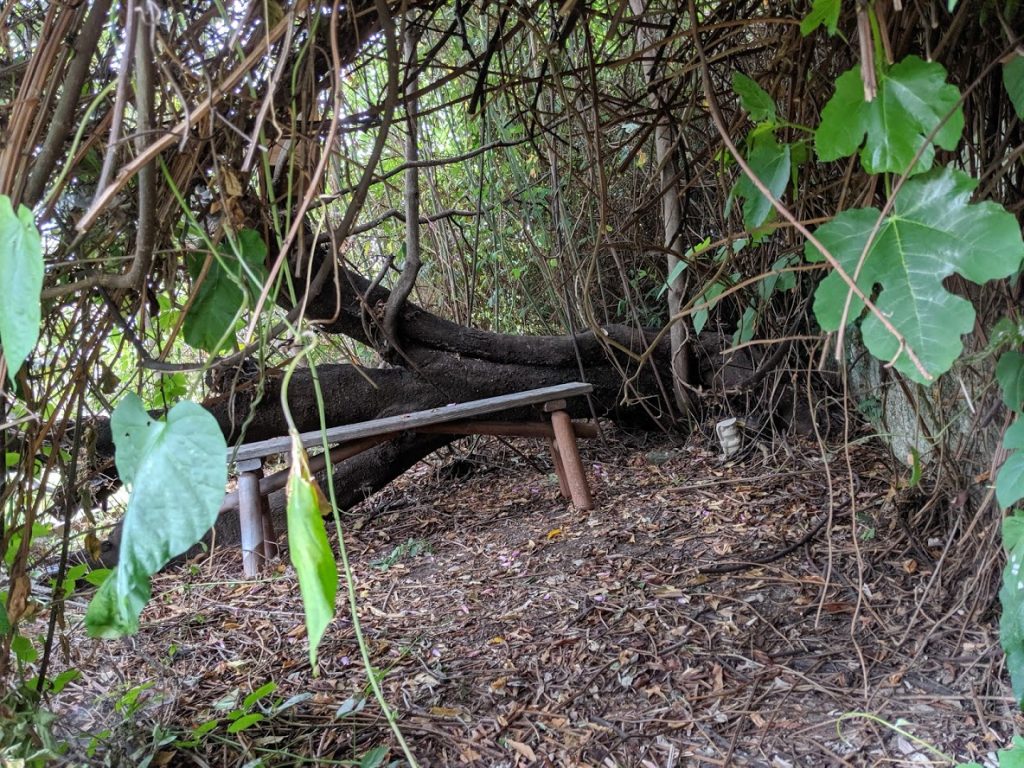
Oh that’s right my friends, we (and by “we,” I mean Sam, but he did it because I asked him to) hacked back the briars just enough to create an awesomely spooky little tunnel into a secret world that looks like this:
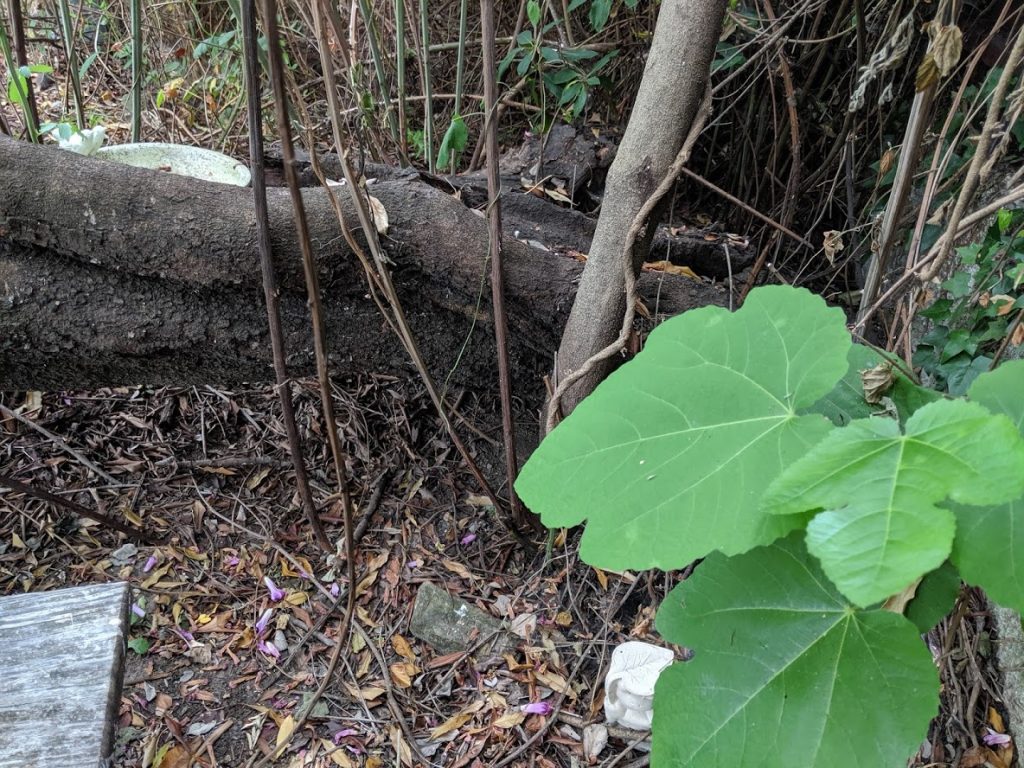
See? That’s the tree that fell over. When we first moved in I envisioned this as a place for the boys to play, a natural tree fort, but the truth is they spend almost no time there because they’ve got Fortnite and YouTube instead.
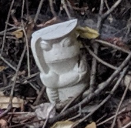
I’m the one who likes to go out there and sit, because I find it a meditative and a magical place. A secret grove where the fae energy is strong. I dragged that bench in there, and put the little froggo statue at the tree’s roots, along with a birdbath. As decorations, or offerings.
As an offering to what? I dunno. I am an atheistic nature worshipper, a lapsed witch. It’s just an offering to life, mostly, because I’m super inspired by this mock orange tree that fell over and refused to die. And I love the little world that it created by continuing to flourish while having a bit of an extended lie-down. I come and fill up the bowl with water sometimes, though I also intentionally let it run dry in between, to keep mosquitoes from breeding there. It means something to me, though I couldn’t necessarily say what.
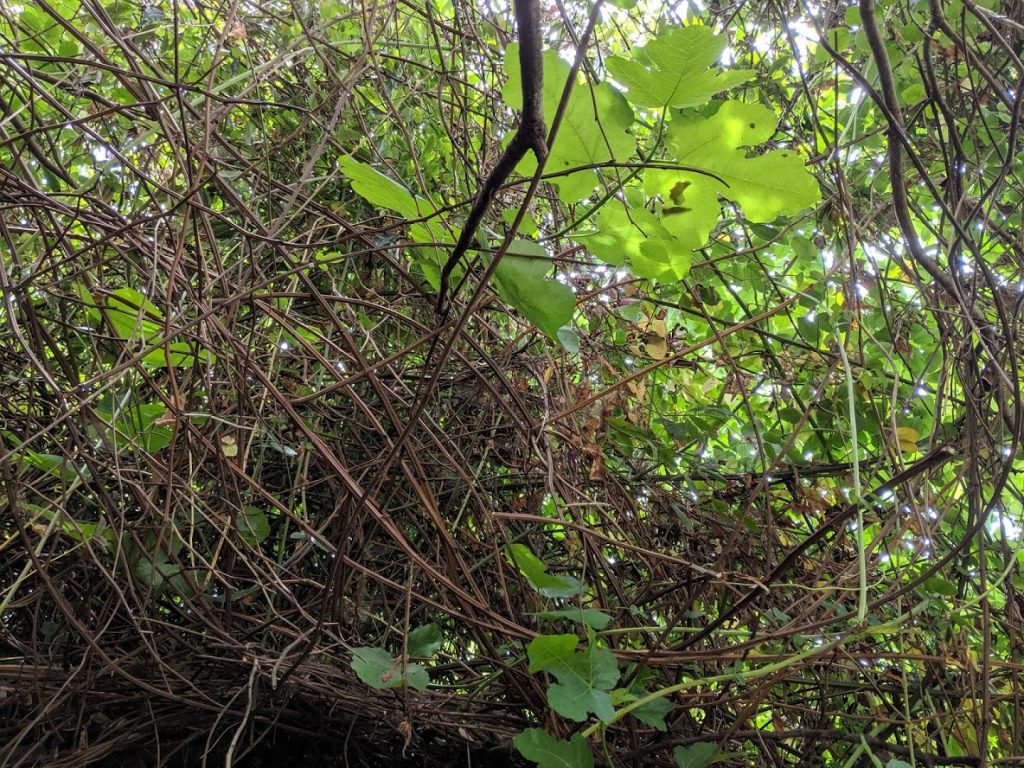
In my head I’ve called this spot the Green Chapel, or sometimes the Briar-Bower. If you sit on the bench and look up over your head, it looks like this:
The big leaves are a fig tree that’s spilling over from the neighbor’s yard, and supporting some of the smaller vines as it does. I think sometimes about that song from Hamilton, about sitting under your own vine and fig tree. I mean it’s from the Bible. Everyone shall sit under their own vine and fig tree, and no one shall make them afraid. But I think of it in Hamilton form, and I hum it a little bit sometimes, and usually by the time I come on out from under there, I feel comforted.
I'm a writer and mom living in Oakland. This is my personal blog; I write about parenting, cooking, local issues, books, and anything else that's rattling around inside my head.
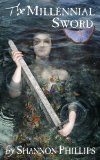
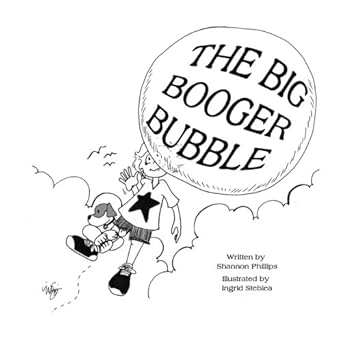
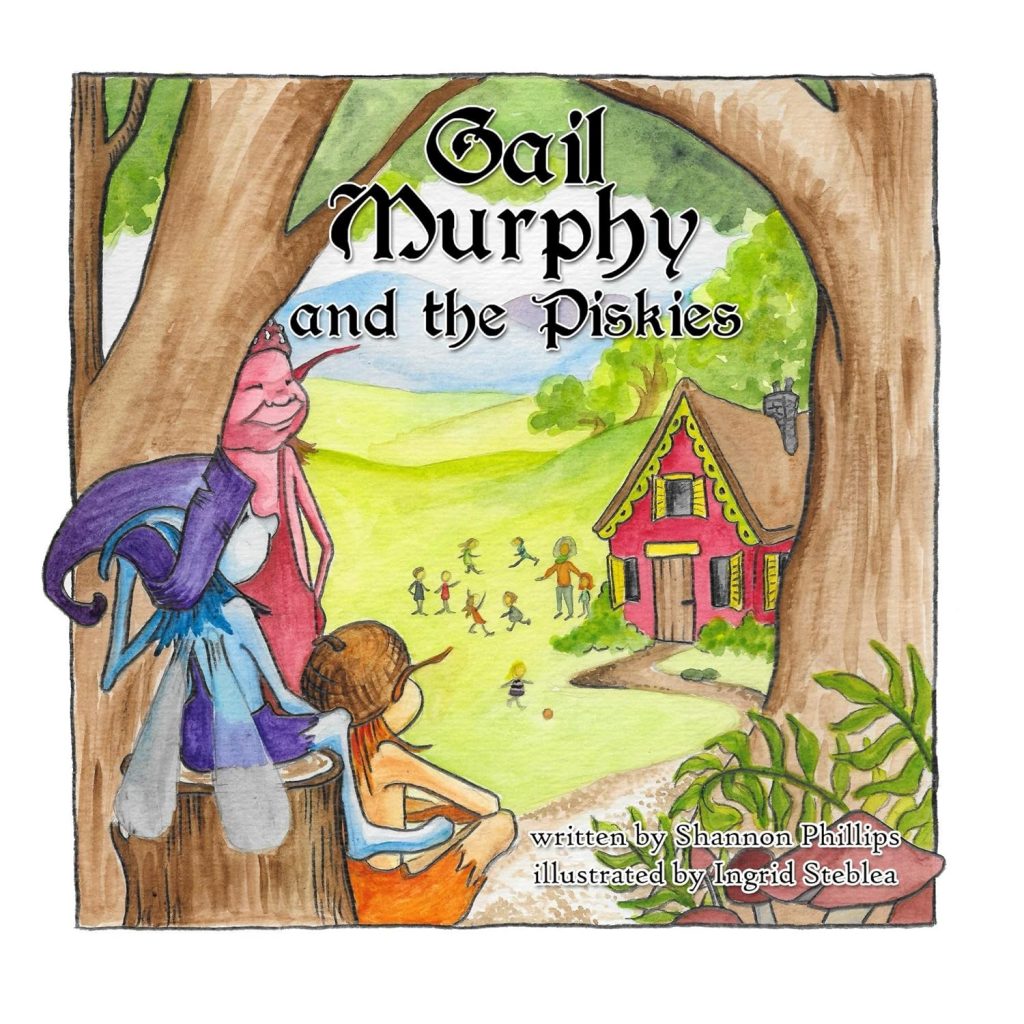
I am the author of The Millennial Sword, an urban fantasy novel set in San Francisco, and two read-aloud picture books for kids, The Big Booger Bubble and Gail Murphy and the Piskies.
Contact me by e-mail: shannon@sonic.net
My short fiction is included in the anthologies Fae, Love Hurts, and Speculative Story Bites: